Bonus: How DataHub Structures Metadata Internally
The Building Blocks of DataHub
The core modules covered how to use DataHub day to day; this bonus module looks under the hood at how it represents the world.
Four concepts you will use in every interaction with DataHub:
- Entities
- Aspects
- URNs (Uniform Resource Names) — each entity's permanent ID
- Domains
What Is an Entity?
- An entity is a specific "thing" that DataHub tracks -- think of it as one row in a directory
- DataHub tracks many kinds of entities; the major ones:
- Dataset: table, view, topic, file, or any structured data asset
- Dashboard: a Looker dashboard, Tableau workbook, etc.
- Chart: an individual chart or visualization
Entities Have...
- Every entity has a unique resource name (URN) -- its permanent ID, assigned when the entity is created and never changed
- Almost every entity also has a human-readable name -- the friendly label you see in the UI
- Example: the table you see as fact_revenue_daily is, under the hood,
urn:li:dataset:(urn:li:dataPlatform:snowflake,PROD.FINANCE.FACT_REVENUE_DAILY,PROD) - The URN looks scary, but you rarely type one -- the UI handles it; you just need to recognize one when you see it
Entity vs. Entity Type: Don't Mix These Up
- Entity type: the category (Dataset, Dashboard, User...)
- Entity: a specific instance of that type
- Dataset: urn:li:dataset:(urn:li:dataPlatform:snowflake,PROD.FINANCE.FACT_REVENUE_DAILY,PROD)
- Dashboard: urn:li:dashboard:(looker,dashboards.42)
- User: urn:li:corpuser:jsmith
- The confusion shows up in bug reports: "The entity is wrong" -- which entity, specifically?
What Is an Aspect?
- An aspect is a named bundle of properties attached to an entity
- One entity has many aspects -- each aspect holds one category of metadata
- Example: the FACT_REVENUE_DAILY Dataset entity has these aspects, among others:
- SchemaMetadata: column names, data types, field descriptions
- DatasetProfile: row counts, null counts, sample values
- Ownership: who owns this dataset (and in what role)
- GlobalTags: tags applied to this dataset
Aspects Are Modular by Design
- Multiple systems can write different aspects to the same entity simultaneously
- Example flow for FACT_REVENUE_DAILY:
- Snowflake ingestion writes the SchemaMetadata aspect (columns, types)
- dbt ingestion writes the DatasetProperties aspect (description)
- Airflow integration writes the DataJobInputOutput aspect (pipeline linkage)
- Data steward (UI) writes the Ownership aspect (assigns an owner)
- Governance team writes the GlobalTags aspect (adds a PII tag)
What Is a URN? The Permanent Identity of Every Entity
- URN stands for Uniform Resource Name
- Every entity in DataHub has exactly one URN -- it never changes
- Format: urn:li:<entity-type>:(<identifier>)
- Snowflake table: urn:li:dataset:(urn:li:dataPlatform:snowflake,PROD.FINANCE.FACT_REVENUE_DAILY,PROD)
- Looker dashboard: urn:li:dashboard:(looker,dashboards.42)
- Individual user: urn:li:corpuser:jsmith
Always Reference Assets by URN in Scripts and API Calls
- Use URNs, not display names, whenever referencing an asset programmatically
- Display names can change. URNs cannot.
- In API calls: pass the full URN as the entity identifier
- In bug reports or support tickets: include the URN so the exact asset is unambiguous
- In scripts: resolve the display name to a URN once at the start, then use the URN throughout
- Where to find a URN: the entity's URL in the DataHub UI contains it (URL-encoded)
Reading URNs Directly from the Browser URL
- When you navigate to any entity in the DataHub UI, the URN is in the URL
- Example URL: https://your-datahub.example.com/dataset/urn%3Ali%3Adataset%3A%28urn%3Ali%3AdataPlatform%3Asnowflake%2CPROD.FINANCE.FACT_REVENUE_DAILY%2CPROD%29
- URL-decoded, the path after /dataset/ is: urn:li:dataset:(urn:li:dataPlatform:snowflake,PROD.FINANCE.FACT_REVENUE_DAILY,PROD)
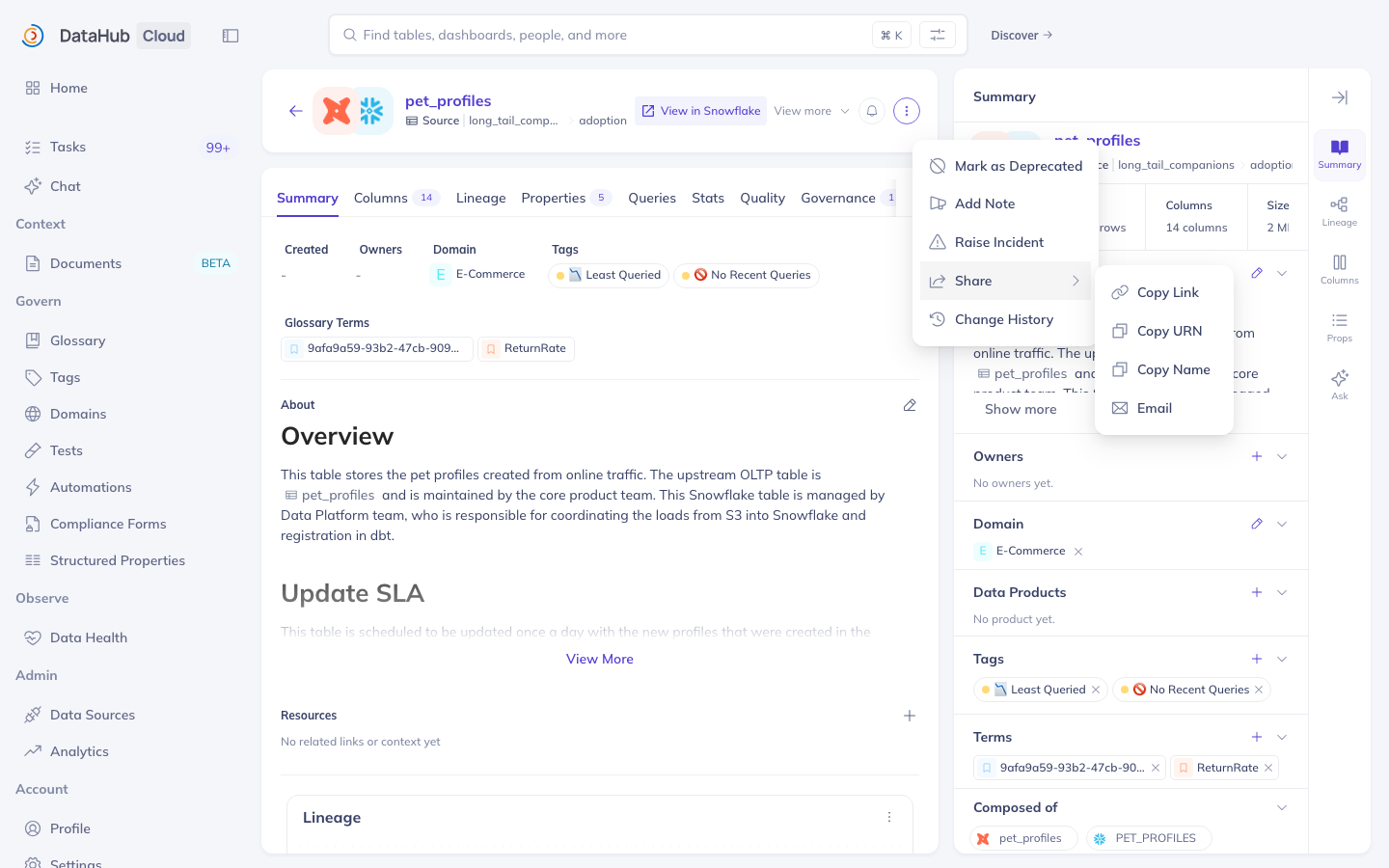
Brief: Screenshot of a DataHub dataset entity page with the full browser address bar visible, showing the URL-encoded URN in the path after /dataset/.
What Is a Domain? The Organizational Layer
- A domain is a named business grouping that organizes assets in DataHub
- Example domains: Finance, Marketing, Engineering, Risk, Compliance, Data Science
- Every asset can be assigned to one domain -- set via the sidebar, replaces the existing assignment
- Domains are set up by admins, but visible and useful for everyone
- What domains enable:
- Navigation: browse the "Finance domain" to see all Finance assets in one place
- Governance: policies and Data Products can be scoped per domain
- Discovery: filter any search by domain to narrow results instantly
How Entities, Aspects, URNs, and Domains Fit Together
- Every asset in DataHub can be described with these four concepts working together
- Example: the FACT_REVENUE_DAILY Snowflake table
- Entity: PROD.FINANCE.FACT_REVENUE_DAILY (a Dataset entity)
- URN: urn:li:dataset:(urn:li:dataPlatform:snowflake,PROD.FINANCE.FACT_REVENUE_DAILY,PROD)
- Aspects: SchemaMetadata -- 47 columns, types; Ownership -- owned by finance-data-team group
- Domain: Finance (the business domain this dataset belongs to)
Explore a Live DataHub Instance
- Your task (5 minutes):
- Navigate to the live DataHub instance shared in the session setup
- Search for any dataset in the catalog
- Open the entity page and locate:
- The entity's URN (click "Copy URN" or read it from the URL)
- The domain this entity belongs to
- At least two aspects visible on the page (e.g., the Columns tab = SchemaMetadata, the Owners section in the sidebar = Ownership aspect)
Assign Domains Based on Who Governs the Asset, Not Who Uses It
- Rule: an asset belongs to the domain of the team responsible for its quality, governance, and lifecycle
- Not: the domain of every team that queries it
- Example: FACT_REVENUE_DAILY is owned and governed by the Finance data team
- It is also consumed by Marketing and Executive Reporting
- Correct domain: Finance (governance determines domain, not consumption)
- Consumption relationships are tracked separately via lineage and subscriptions
Check for Understanding
- I have an Airflow DAG called daily_revenue_pipeline. What entity type is it in DataHub, and what would its URN look like?
- A data engineer says "the entity is missing its owner." What is wrong with this statement, and what information is missing?
- Your company has a dataset that is used by the Finance team but owned and governed by the Data Engineering team. Which domain should it be assigned to?
Summary: The Four Building Blocks
- Entity: a specific trackable thing in DataHub (Dataset, Dashboard, Pipeline, User, etc.)
- Aspect: a named bundle of properties on an entity (Schema, Ownership, Tags, Profile...)
- URN: the permanent, unique identifier for every entity -- use it in scripts and API calls
- Domain: the business grouping that places an asset in the org chart and scopes governance
- Key rule to remember: entity type vs. entity (specific instance) -- always be specific